
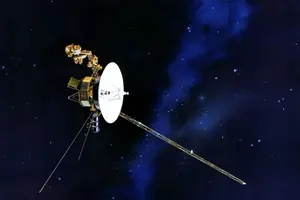
The marvelous journey of the farthest spacecraft ever created by humanity – the story of Voyager 1
Imagine a computer built in the 1970s, long before the internet, smartphones, and the computers we know today. Now imagine it is located nearly 26 billion kilometers from Earth, with no way to replace a component, connect it to power, or send a technician. Yet this computer still works. It receives commands, sends data, and even receives software updates remotely. This is not a scenario from a science‑fiction movie. It is what happens every day aboard NASA’s Voyager 1 spacecraft, which was launched 49 years ago, on September 5, 1977, and has been drifting farther away from us ever since. Next week, on Wednesday, November 18, it is expected to reach a historic milestone: a distance of one light‑day from Earth. That is the distance that even light, the fastest thing in the universe, takes 24 hours to travel. Voyager 1 will be the first human‑made object to reach that distance. But to appreciate how extraordinary this achievement is, we need to go back almost five decades to a spacecraft that was sent to explore two planets and eventually became the most distant traveler in human history.
Automatic translation by Google
Curated from Walla! Culture. Classified as Culture & Education by AI, which sometimes makes mistakes.